
3rd MITGEST training week (Poland)
The third week of the MITGEST training was held from 6th to 13th July 2025 in the beautiful city of Warsaw, Poland. Hosted by the Institute of Biochemistry and Biophysics of the Polish Academy of Sciences (IBB PAN), the week-long event brought together doctoral candidates (DCs), principal investigators (PIs), and partners from the consortium. The meeting was a vibrant blend of science, knowledge exchange, warm reunions and networking.
The training week commenced with presentations by DCs showcasing the progress in their research projects. These sessions offered a valuable opportunity to exchange ideas and receive feedback from peers as well as mitochondrial experts. To complement these updates, the participants attended lectures delivered by invited external speakers. These included talks on mitochondrial gene expression, maintenance and a session by a representative from Baseclick on how to establish a biotech company. A new addition to this year’s program was a session focused on career transitions, where speakers shared personal experiences and advice on moving from academia to industry, and on launching start-ups. On the third day, accelopment hosted a hands-on grant writing workshop, guiding participants through the process of identifying funding opportunities and building strong, competitive proposals.
Programme
09:00 Welcome & Introduction, Carlo Vascotto (IMol) and Roman Szczęsny (IBB)
09:15 DC presentations, Part I Progress update (15min presentation + 5min questions per DC) DCs 1 and 2-5 (3 DCs) WP1-4
10:25 Coffee break
11:00 DC presentations, Part II Progress update (15min presentation + 5min questions per DC) DCs 5-7 (3 DCs) WP1-4
12:00 Lunch break
13:15 “End-to-End profiling of the noncoding transcriptome”; Barbara Uszczyńska-Ratajczak (IChB PAS)
14:00 “Nucleo-mitochondrial interactions in unconventional yeast model Candida albicans”; Karolina Łabędzka-Dmoch (University of Warsaw)
14:45 Coffee break
15:15 “Proteolytic regulation of mitochondrial protein complexes”; Karolina Szczepanowska (IMol)
16:00 “From idea to establishing of a company – baseclick as an example”; Stefan Wiedemann (baseclick)
16:30 End of Day 1
09:10 DC presentations, Part III, Progress update, (15min presentation + 5min questions per DC)DCs 8-9, 11 (3 DCs) WP1-4
10:10 Scientific discussion – round table DCs and PIs
10:40 Coffee break
11:00 Working in Science: Industry vs. Academia career path; Anna Perdrix Rosell (Sixfold Bioscience)
11:30 Working in Science: Industry vs. Academia career path; Valentina Cutano (AstraZeneca UK)
12:00 Lunch break
13:00 Working in Science: Industry vs. Academia career path; Fabio Spada (University of Munich)
13:30 SB meeting; Carlo Vascotto (IMol)
14:00 Outreach session; Joanna Plesniak (accelCH) and OST (DCs 5, 6, 7, 11)
15:00 End of Day 2
17:30 Guided tour of Warsaw, followed by a dinner
09:00 Funding opportunities; Jacqueline Strehler, Joanna Plesniak (accelCH)
11:00 Coffee break
11:15 Proposal writing; Jacqueline Strehler, Joanna Plesniak (accelCH)
13:00 Lunch break
14:00 Bioinformatics Summer School; Barbara Uszczyńska-Ratajczak, Marta Blangiewicz, Tomasz Mądry (IChB PAN)
15:15 Coffee break
15:30 Bioinformatics Summer School – continuation
17:00 End of day 3
09:00 Bioinformatics Summer School; Barbara Uszczyńska-Ratajczak, Marta Blangiewicz, Tomasz Mądry (IChB PAN)
10:30 Coffee break
10:50 Bioinformatics Summer School – continuation
12:50 Lunch break
13:50 Bioinformatics Summer School – continuation
16:15 End of day 4
09:00 Bioinformatics Summer School; Barbara Uszczyńska-Ratajczak, Marta Blangiewicz, Tomasz Mądry (IChB PAN)
10:30 Coffee break
10:50 Bioinformatics Summer School – continuation
12:50 Lunch break
13:50 Bioinformatics Summer School – continuation
16:15 End of day 5
09:00 Business for Science; Paul Toombs (CRAC/Vitae)
10:30 Coffee break
10:50 Business for Science – continuation
12:50 Lunch break
13:50 Business for Science – continuation
16:00 End of day 6and MITGEST week
DEPARTURES
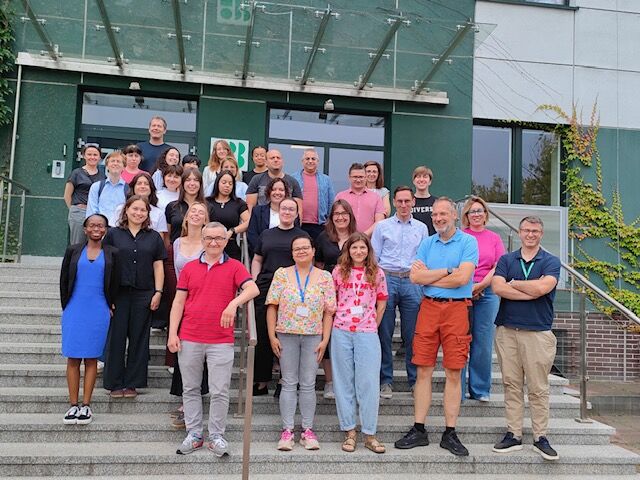
MITGEST network PIs and DCs
MITGEST group picture
Nioinformatics Summer School
DCs during hands-on workshops on bioinformatics
Bioinformatics Summer School DCs
DCs learning new approaches
Industry insights
Anna Perdrix Rosell is sharing Sixfold Bioscience’s success story
Dinner
Networking and dining in a traditional Polish restaurant
A glimpse into the training week


Insightful scientific talks
The MITGEST training week was enriched by a series of scientific talks that showcased cutting-edge research across diverse areas of molecular biology. Barbara Uszczyńska-Ratajczak (IChB PAS) opened the session with a talk on “End-to-End profiling of the noncoding transcriptome,” offering insights into the complexities of RNA biology and the powerful methodologies used to uncover regulatory elements beyond the coding genome. Karolina Łabędzka-Dmoch (University of Warsaw) followed with a presentation on “Nucleo-mitochondrial interactions in unconventional yeast model Candida albicans,” highlighting the unique aspects of mitochondrial communication in this emerging model organism. The final talk by Karolina Szczepanowska (IMol), “Proteolytic regulation of mitochondrial protein complexes”, delved into the fine-tuned control mechanisms governing mitochondrial function. Together, these talks provided participants with a broad yet detailed view of current scientific questions and experimental strategies in the field.

Bridging Science and Career Pathways
A new highlight in this year’s programme was the tailored training track, designed to support DCs in navigating key career development milestones. One standout session focused on career transitions, where Anna Perdrix Rosell (Sixfold Bioscience), Valentina Cutano (AstraZeneca UK), and Fabio Spada (University of Munich) shared honest and insightful testimonials about their paths through academia, industry and entrepreneurship. Their stories offered practical perspectives on the opportunities and challenges involved in each setting, sparking lively discussion and reflection among participants.
On Day 3, accelopment delivered a hands-on grant writing workshop, equipping researchers with the tools to identify suitable funding opportunities and structure strong, competitive proposals. The session combined practical guidance with peer exchange, and placed particular emphasis on effective science communication, helping participants learn how to articulate the relevance and impact of their research in a compelling, accessible way.
Together, these tailored sessions added real-world context and transferable skills to complement the scientific focus of the programme.
Bioinformatics Summer School
The second half of the week featured an engaging 2.5-day Bioinformatics Summer School led by experts from IChB PAN, offering our DCs an immersive introduction to RNA sequencing data analysis. Through hands-on sessions using real datasets, participants were guided step by step in applying bioinformatics tools to address concrete biological questions. The training balanced technical skill-building with critical thinking, helping DCs not only navigate complex workflows but also interpret results and draw meaningful scientific conclusions. With expert support and a highly practical format, the summer school empowered participants to connect bioinformatics methods directly to their own research contexts.

Business for Science workshop
Vitae, an organization committed to advancing the professional development of researchers globally, plays a vital role in nurturing the next generation of professionals poised to make meaningful contributions to their fields. In this spirit, Paul Toombs led an inspiring and practical workshop to help our DCs explore the intersection of research and enterprise. The one-day session introduced participants to the core principles of creativity, innovation and entrepreneurship, with targeted activities that encouraged them to identify commercialisation opportunities within their own research. Through guided exercises, the group explored the stages of entrepreneurial thinking, from creative problem-solving to business planning using a visual model. The afternoon focused on collaboration, networking, and personal competencies needed for enterprise success. With Paul’s engaging facilitation and deep expertise, participants left with a greater appreciation of the wider value of their research and actionable strategies to bring enterprising ideas to life.
The third MITGEST Training Week was a great success, combining high-level scientific training with career development, collaboration and community building. The energy and engagement of all participants made it a memorable event.