
What is mitochondrial RNA? A life story in Your cells...
Have you ever wondered how mitochondrial RNA lives, works, and gets recycled inside your cells?
Now you can learn all about it in a fun and accessible way, thanks to the brand-new educational animation created by MITGEST doctoral candidates Dory Vergallo (DC3) and Giulia Santonoceto (DC5). The short animated video brings to life the journey of mitochondrial RNA, from its birth to its crucial roles in energy production, all the way to its final recycling steps. This video is part of MITGEST’s ongoing commitment to science communication and patient engagement. Designed for non-specialist audiences, including patients, families, and the broader public, it transforms complex molecular biology into a vivid and engaging story.
A Creative Challenge
We sat down with Dory and Giulia to learn more about the creative process behind the animation.
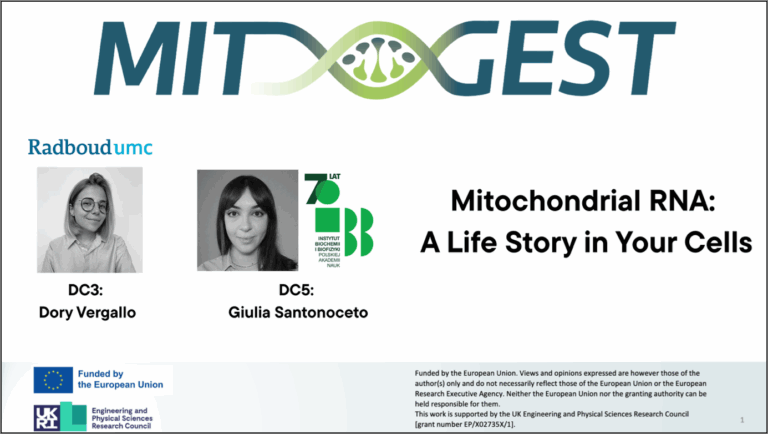

What inspired them to take on this unique science communication project?
We wanted to explain mitochondrial RNA biology in a simple, relatable way,” said Dory. “The life cycle of RNA shares many similarities with human life—it’s born, works hard, and eventually retires. This concept became the foundation of our narrative.” The decision to create a video stemmed from a desire to step beyond traditional formats and make science more inclusive.
“We thought animation would be the perfect medium to reach wider audiences—especially those without a scientific background,” added Giulia.
To bring this story to life, they used Canva for animation and incorporated AI tools for the voiceover, creating a clean, playful visual style paired with a warm, friendly narration. “We learned a lot through this process,” said Giulia. “It was our first time developing a scientific animation from scratch, and while it was challenging, it was also a lot of fun. Translating scientific processes into visuals that are both accurate and enjoyable required creativity, flexibility, and teamwork.”
From RNA to Real Impact

In the video, mitochondrial DNA takes the role of a cheerful narrator guiding the viewer through the “life” of mitochondrial RNAs. The audience learns how RNAs are made, processed, and eventually degraded, and why these steps are crucial for healthy mitochondrial function.
Creating this video was a way to give visibility to their research while also learning how to communicate science more effectively. “We hope that by using storytelling and animation, we can make our research more accessible,” added Dory. “Mitochondrial disorders are complex, but understanding the basics can help patients and families feel more informed and empowered.”
In doing so, they discovered how much they could grow professionally from the experience. “This project helped us develop communication skills we don’t normally get to use in the lab,” said Giulia. “We feel more confident now in translating complex ideas into clear, compelling messages.”
What surprised you most during the making of the video?
“How difficult it is to strike the right balance between scientific accuracy and simplicity,” said Giulia. “We constantly asked ourselves, is this too much detail, or not enough? We also didn’t expect just how much work goes into even a short animation, from scripting to timing visuals with narration. It gave us a new appreciation for science communicators!”
Dory added, “I was surprised by how creative the process could be. As researchers, we’re used to being precise and analytical, but here, we had to think like storytellers and designers. It pushed us out of our comfort zone in the best way.”
Meet the Researchers

Dory Vergallo (DC3)
studies how mitochondrial RNAs are produced and undergo quality control.

Giulia Santonoceto (DC5)
investigates how aged or faulty mitochondrial RNAs are degraded.
Through this creative project, both researchers have discovered new ways to engage with the public and share the impact of their work.
“Science communication doesn’t have to be dry or overly technical,” said Giulia. “We believe tools like animation can spark curiosity and help bridge the gap between scientists and society.”
Watch the Video!
You can now watch the full animation here on our YouTube channel: youtube.com/@MITGEST_EU
Thank you to everyone who supported the production, and stay tuned for more adventures.