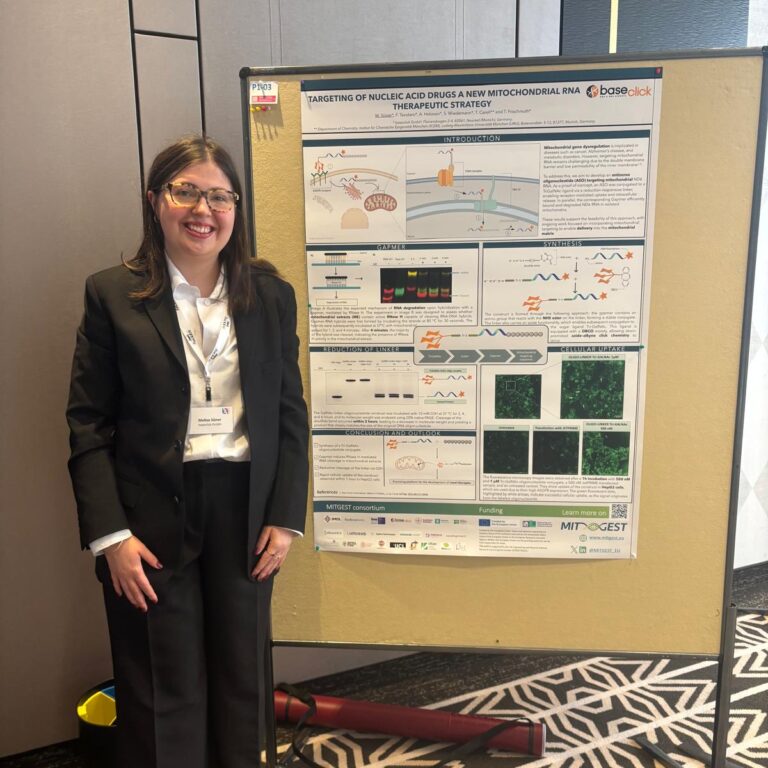
MITGEST’s DC9 Melisa Süner recently attended TFmed 2026, a four-day conference held from April 13-16 in Frankfurt am Main, Germany. The meeting brought together researchers, clinicians, and industry professionals working in translational medicine and was the first joint conference of the three Clusters4Future initiatives PROXIDRUGS, CNATM, and CURATIME.
The conference covered a wide range of new therapeutic approaches, from proxidrugs such as PROTACs and molecular glues to mRNA, antisense technologies, and cell therapies. These were discussed in the context of many different diseases, including cancer, neurodegeneration, inflammation, diabetes, and cardiovascular disorders. For Melisa, one of the most valuable aspects of the event was this broad scientific scope and the fact that many sessions were designed for a highly interdisciplinary audience. For example, a talk by Professor Michael Bronstein (AITHYRA) on how AI tools can be used for biological data explained the topic in a way that was accessible even without prior computational knowledge. This allowed her to follow developments outside her own specialisation and take away ideas from fields she would not usually work in directly.
One talk that stood out to her was given by Dr Aman Ishaqat from the Technical University of Munich, who presented her work on carbohydrate-coupled inhaled anti-microRNA therapy for macrophage-targeted reprogramming in COPD.
“I found this particularly interesting because it also involves conjugating a sugar ligand to an oligonucleotide, which is closely related to my own work,” Melisa said. “It was also exciting to see this strategy already being explored in a therapeutic disease setting.”
Melisa also presented her poster, Targeting of Nucleic Acid Drugs: A New Mitochondrial RNA Therapeutic Strategy, during the poster sessions. This led to interesting discussions with other participants and gave her the chance to receive feedback and hear different perspectives on her project.
Overall, TFmed 2026 provided a great opportunity for scientific exchange and networking, especially in such an interdisciplinary setting. For Melisa, the meeting was both inspiring and motivating, highlighting how closely her own research connects to current developments in nucleic acid therapeutics.